
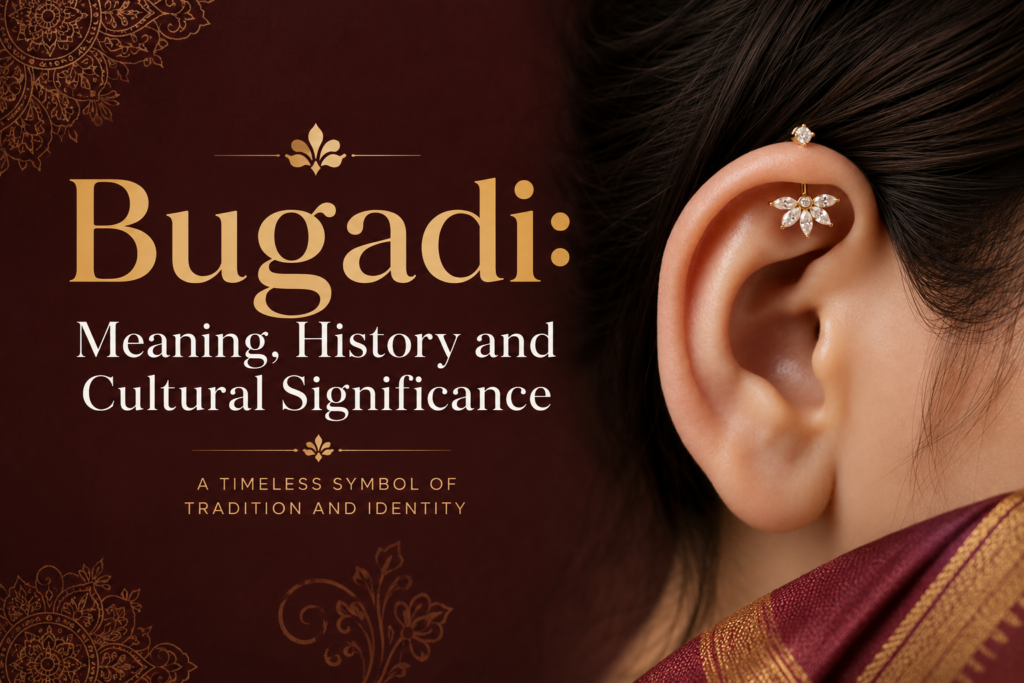
carries stories of tradition.
Some ornaments are worn for beauty. Others also reflect regional identity, customs, and heritage. Bugadi is one such traditional ear ornament.
Known for its distinctive placement and decorative character, Bugadi has a strong connection with traditional Indian adornment. It is especially associated with Maharashtrian jewelry traditions and ceremonial dressing.
Today, Bugadi is also appearing in contemporary bridal and festive jewelry collections. Its designs may have evolved, but its traditional character remains recognizable.
This guide explores what Bugadi is, its history, cultural significance, traditional symbolism, regional context, and evolution from traditional to modern designs.
What Is Bugadi?
Bugadi is a traditional Indian ear ornament. It is commonly associated with Maharashtrian jewelry traditions.
Unlike ordinary earrings, Bugadi is traditionally worn through a piercing in the upper cartilage or upper part of the ear. Its exact placement can vary depending on the style and regional practice.
Traditional Bugadi designs are often small and decorative. They may feature:
- Gold
- Precious or semi-precious stones
- Beaded details
- Engraved patterns
- Traditional motifs
The ornament can be worn alone or as part of a larger traditional jewelry arrangement.
Its distinctive placement gives Bugadi its unique visual identity.
The Origin and History of Bugadi
Bugadi has a long association with the traditional jewelry culture of Maharashtra.
Jewelry in the region historically developed around local customs, craftsmanship, social traditions, and ceremonial dressing. Different ornaments were created for different parts of the body.
Bugadi became recognized as an ornament worn on the upper part of the ear. Over generations, it became part of traditional Maharashtrian adornment.
However, the precise historical origin and earliest use of Bugadi are not consistently documented in accessible historical sources. Therefore, specific claims about an exact period or single origin should be treated cautiously.
What is clearer is its longstanding presence within Maharashtrian traditional jewelry.
Its continued use shows how regional ornaments can remain culturally relevant across generations.
Bugadi and Maharashtrian Jewelry Tradition
Maharashtrian jewelry is known for distinctive ornaments and recognizable design traditions.
Bugadi forms part of this broader jewelry heritage.
Traditional Maharashtrian jewelry often combines gold with detailed craftsmanship. Many pieces are associated with weddings, festivals, religious occasions, and other important cultural events.
Bugadi fits naturally within this tradition because it combines:
- Regional identity
- Traditional craftsmanship
- Decorative beauty
- Ceremonial dressing
It is not simply another type of earring. Its specific ear placement and regional association give it a distinct identity.
Cultural Significance of Bugadi
Bugadi represents more than decoration in traditional settings.
Jewelry has historically played an important role in expressing cultural identity. Regional ornaments can communicate a connection with family traditions, community customs, and local craftsmanship.
Bugadi’s cultural importance comes largely from this connection with Maharashtrian heritage.
For many traditional jewelry enthusiasts, wearing such an ornament can be a way of incorporating regional heritage into ceremonial dressing.
Its significance can therefore be understood through three key ideas:
Regional Identity
Bugadi is strongly associated with Maharashtrian jewelry culture.
Traditional Adornment
It forms part of the broader tradition of decorating the body with region-specific ornaments.
Cultural Continuity
Its continued presence in modern jewelry collections reflects the ongoing interest in traditional designs.
Traditional Meaning and Symbolism of Bugadi
Traditional Indian jewelry often carries symbolic meanings. However, these meanings can vary across communities, families, regions, and traditions.
Bugadi is sometimes discussed in the context of traditional femininity, cultural identity, and ceremonial adornment.
It is important not to treat every traditional belief as a scientifically established fact.
The safest way to understand Bugadi’s symbolism is through its cultural context.
A Symbol of Tradition
Wearing Bugadi can represent a connection with inherited jewelry traditions.
A Marker of Regional Heritage
Its strong association with Maharashtra gives it regional cultural significance.
Part of Ceremonial Adornment
Bugadi is often incorporated into traditional dressing for important occasions, particularly weddings and festivals.
These meanings are cultural rather than universal rules. The significance attached to Bugadi can differ from one wearer or family to another.
Regional Context of Bugadi
Bugadi is most strongly associated with Maharashtra.
Maharashtra has a rich tradition of distinctive jewelry forms. Many ornaments are closely connected with local clothing, ceremonies, and regional identity.
Bugadi is particularly recognizable because of its placement on the upper ear.
Its regional identity is important when understanding the ornament. Calling every similar upper-ear ornament a Bugadi may overlook differences in local terminology and design traditions.
Different regions may have their own names and variations for ear ornaments. Designs can also change according to local craftsmanship and contemporary jewelry trends.
Therefore, Bugadi is best understood within the broader context of Maharashtrian traditional jewelry.
Bugadi in Traditional Ceremonial Wear
Traditional jewelry becomes especially important during ceremonies.
Weddings, festivals, religious celebrations, and cultural events often provide opportunities to wear heritage jewelry.
Bugadi can form part of such ceremonial dressing because it adds a distinctive traditional detail to the overall appearance.
Its importance is not necessarily based on its size.
Instead, its unique placement and cultural association make it visually recognizable.
Traditional jewelry sets may combine Bugadi with other ornaments to create a coordinated ceremonial look.
Why Is Bugadi Associated with Bridal Wear?
Bridal jewelry often reflects cultural heritage.
Different communities have their own traditional bridal ornaments. These pieces can represent family customs, regional identity, and ceremonial traditions.
Bugadi is associated with bridal dressing particularly within Maharashtrian cultural contexts.
For a traditional Maharashtrian bridal look, jewelry can be an important part of completing the overall appearance. Bugadi may be included alongside other traditional ornaments.
Its bridal relevance comes from several factors:
Cultural Heritage
Traditional bridal jewelry often preserves regional customs.
Distinctive Appearance
The upper-ear placement creates a recognizable detail.
Traditional Jewelry Sets
Bugadi can complement other Maharashtrian jewelry pieces.
Ceremonial Association
Its connection with traditional adornment makes it suitable for important occasions.
However, Bugadi is not exclusively a bridal ornament. It can also be worn for festivals, cultural celebrations, and other traditional occasions.
Bugadi in Traditional Maharashtrian Bridal Jewelry
A Maharashtrian bridal jewelry collection can include several distinctive ornaments.
The exact combination depends on personal preference, family tradition, regional practice, and the desired bridal style.
Bugadi can be incorporated as one element within this larger jewelry arrangement.
Its role is often to add detail around the upper ear while complementing other traditional ornaments.
This is one reason Bugadi continues to attract interest among brides who want a distinctly traditional appearance.
Traditional Bugadi Designs
Traditional Bugadi designs generally emphasize craftsmanship rather than excessive size.
Gold has historically been an important material in Indian traditional jewelry. Traditional Bugadi may feature detailed gold work and small decorative elements.
Some designs may incorporate:
- Floral motifs
- Geometric details
- Beaded elements
- Gemstone accents
- Engraved patterns
Design characteristics can vary between artisans and jewelry collections.
The traditional appearance generally remains rooted in detailed craftsmanship and regional aesthetics.
How Bugadi Has Evolved Over Time
Traditional jewelry does not remain completely unchanged.
Modern jewelry designers often reinterpret heritage ornaments for contemporary consumers.
Bugadi has also appeared in more modern forms.
The changes may include:
- Lighter designs
- Smaller sizes
- Contemporary finishes
- New decorative elements
- Alternative materials
- Simplified patterns
These changes make the ornament easier to incorporate into modern outfits.
Yet the defining idea remains the same: a distinctive traditional ear ornament associated with regional jewelry heritage.
Traditional Bugadi vs Modern Bugadi
The difference is mainly in design and presentation.
| Traditional Bugadi | Modern Bugadi |
| Strong regional character | Traditional influence with contemporary styling |
| Often detailed craftsmanship | May use simplified designs |
| Commonly associated with gold | May be available in different materials |
| Traditional motifs | Traditional and modern motifs |
| Ceremonial styling | Bridal, festive, and fashion styling |
Modern adaptations do not necessarily replace traditional versions.
Instead, they provide additional ways to wear a heritage-inspired ornament.
Why Bugadi Still Matters Today
Traditional jewelry continues to evolve because people find new ways to incorporate heritage into modern life.
Bugadi remains relevant because it offers something distinctive.
It connects:
Traditional craftsmanship → Regional identity → Modern styling
For some wearers, the attraction is cultural. For others, it is the ornament’s unique appearance.
For brides, it can provide a subtle connection to traditional jewelry heritage without requiring the entire look to remain strictly traditional.
Bugadi as a Heritage Ornament
Bugadi represents how jewelry can preserve cultural identity.
Its value is not limited to its decorative function. Its regional association gives it a place within the history of Indian jewelry traditions.
The continued availability of Bugadi-inspired designs also shows how traditional ornaments can adapt to changing preferences.
A heritage ornament does not have to remain unchanged to remain meaningful.
Its designs can evolve while its cultural connection continues.
Frequently Asked Questions About Bugadi
Is Bugadi a Maharashtrian jewelry ornament?
Yes. Bugadi is strongly associated with traditional Maharashtrian jewelry.
Where is Bugadi worn?
Bugadi is traditionally worn on the upper part of the ear, often through an upper-ear cartilage piercing. The exact placement can vary by design and tradition.
Is Bugadi only worn by brides?
No. Although it can be part of traditional bridal jewelry, Bugadi can also be worn for festivals, ceremonies, and cultural occasions.
Is Bugadi traditionally made of gold?
Traditional Bugadi designs are commonly associated with gold jewelry. Modern versions may be available in other materials and finishes.
Is Bugadi still popular today?
Traditional and contemporary Bugadi designs continue to be available, particularly for bridal, festive, and heritage-inspired styling.
Is Bugadi the same as a normal earring?
No. Its distinctive upper-ear placement is one of the features that separates Bugadi from conventional earrings.
Final Thoughts
Bugadi is more than a decorative ear ornament.
Its connection with Maharashtrian jewelry traditions, distinctive upper-ear placement, and ceremonial use gives it a unique place in Indian jewelry heritage.
From traditional gold designs to contemporary interpretations, Bugadi has adapted to changing preferences while retaining its recognizable character.
For brides and jewelry enthusiasts, it offers an opportunity to bring a piece of regional tradition into a modern celebration.
Understanding its history and cultural context makes the ornament even more meaningful.
The beauty of Bugadi lies not only in how it looks, but also in the tradition it represents.